David Hartmann · 16 November 2026
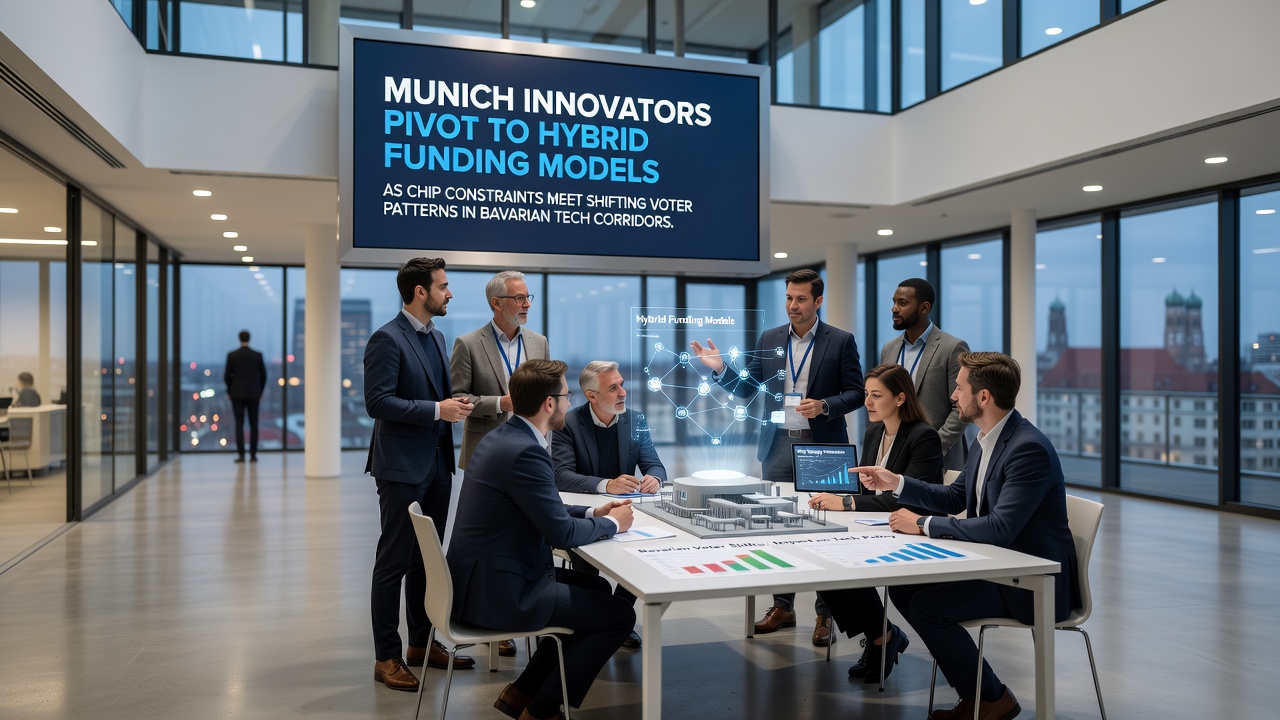
Munich Innovators Pivot to Hybrid Funding Models as Chip Constraints Meet Shifting Voter Patterns in Bavarian Tech Corridors
Companies in Munich's tech corridors have begun combining venture capital with public grants and corporate partnerships to address ongoing semiconductor supply limitations that intensified through 2025. Data from the European Semiconductor Industry Association shows Bavarian firms experienced average lead times of 18 weeks for advanced chips in the first half of 2026, prompting finance teams to restructure capital stacks rather than rely solely on traditional equity rounds.
Chip Supply Pressures Shape Funding Strategies
Infineon Technologies and a cluster of smaller sensor developers along the Munich-Augsburg corridor reported production delays tied to global foundry capacity constraints that persisted after 2023 export controls. Researchers at the Fraunhofer Institute for Applied Solid State Physics documented a 14 percent drop in new prototype tape-outs among Bavarian startups between 2024 and 2025, attributing the decline to both material shortages and rising wafer prices. In response, several firms announced hybrid rounds that pair Series B equity with matching funds from the Bavarian State Ministry for Economic Affairs and the EU Chips Act allocation administered through national agencies.
Observers note that these blended structures reduce dilution while securing access to subsidized fabrication capacity in Dresden and Regensburg. One Munich-based AI hardware startup secured 12 million euros in private investment alongside 8 million euros in non-dilutive grants tied to workforce training commitments in the Oberbayern region, according to filings with the German Commercial Register.
Voter Shifts Influence Local Tech Policy
State election results from October 2023 and subsequent municipal votes revealed changing priorities among voters in districts hosting major tech employers. Turnout patterns showed increased support for platforms emphasizing domestic semiconductor resilience and regional supply chain security, particularly in constituencies around Garching and Unterhaching. Policy analysts at the ifo Institute recorded a measurable uptick in budget line items for applied research facilities in the 2025 Bavarian supplementary budget, reflecting these electoral outcomes.
By November 2026, several corridor municipalities had adjusted zoning approvals and tax incentive packages to favor facilities that incorporate public-private funding agreements. These adjustments aligned with updated state guidelines that prioritize projects demonstrating diversified capital sources over pure venture-backed models.

Hybrid Models in Practice Across Corridors
Implementation varies by company size and sector focus. Automotive electronics suppliers have leaned on partnerships with established Tier-1 manufacturers that provide both capital and guaranteed offtake agreements, while software-adjacent hardware firms have pursued crowdfunding platforms alongside federal research contracts. A 2026 survey by the Bavarian Business Association tallied 37 active hybrid financing deals valued above 5 million euros, up from 19 in the prior year.
Funding structures often include milestone-based tranches linked to technology transfer requirements with local universities. The Technical University of Munich reported a 22 percent rise in industry-sponsored chair positions funded through such arrangements during the 2025-2026 academic year. These positions support applied research in power electronics and photonics, areas directly affected by chip allocation quotas.
Regional Data and External Benchmarks
Figures released by the German Federal Statistical Office indicate that Bavaria accounted for 28 percent of national semiconductor-related patent applications in 2025, yet teh region captured only 19 percent of new venture capital deployments in the same category. The gap has narrowed as hybrid instruments gained traction, with corporate venture arms from automotive and industrial conglomerates contributing larger portions of early-stage capital.
Comparisons with other European clusters appear in a joint report issued by the European Commission and national innovation agencies, which tracks how public matching requirements affect private investment velocity across member states. Separate analysis from the OECD Directorate for Science, Technology and Innovation places Bavarian hybrid activity levels between those observed in the Netherlands and South Korea during the same period.
Outlook Through Late 2026
State budget planning documents scheduled for release in December 2026 outline continued support for blended funding vehicles, contingent on demonstrated progress toward supply chain targets set under the national semiconductor strategy. Corridor municipalities have scheduled additional stakeholder forums to align permitting processes with the capital structures now prevalent among local innovators. These developments continue to unfold against the backdrop of persistent global foundry allocation pressures that show no immediate sign of easing.